
By Stephen Bunting, Specialist MSK Physiotherapist (UK)
This article is about Big Toe Osteoarthritis, which is also referred to Hallux Rigidus or Hallux Limitus. This is a very common condition which affects 1 in 40 people over the age of 50. The article discusses what the condition is, what causes it, how it’s diagnosed and the available treatment options.
The information can also be seen in video format below.
What is Hallux Rigidus / Limitus ?
Hallux Rigidus and Limitus are from the Ancient Greek with ‘Hallux’ meaning the big toe, ‘Rigidus’ meaning totally stiff and ‘Limitus’ meaning partially stiff. So the name essentially describes one of the main symptoms – stiffness of the big toe.

The other main symptom is pain because it’s caused by Osteoarthritis (OA) of the main joint of the big toe – the metatarsophalangeal joint, or MTP joint for short.

Osteoarthritis is a degenerative condition where the joint cartilage becomes thin, the bone ends become roughened and the joint becomes stiff and painful.
Sometimes, an arthritic Big Toe MTP joint can become angled, which is called a Bunion.
 |
| A Typical Bunion |
Other symptoms are redness and swelling of the joint if it becomes inflamed. The symptoms can be similar to some other MSK conditions that you might have heard of.
The first is Gout, which also commonly affects the big toe MTP joint. I’ve covered gout in detail in another article here. And also Rheumatoid Arthritis, which can also affect the big toe joints, and again, Ive explored the differences between OA and RA which you can also see here.
So if your big toe joint is red, swollen and very painful then do get it checked out because it’s important to get early treatment if it is indeed Gout or Rheumatoid Arthritis rather than Osteoarthritis.
How is Big Toe Osteoarthritis Diagnosed ?
The diagnosis is usually made based on having the classic symptoms of joint pain and stiffness at the MTP joint when walking or standing, and then an X-Ray to look at the joint surfaces. This will give an idea as to the degree of joint degeneration and any angulation of the bones.
Below are X-Rays showing mild OA, severe OA and the typical angulation of a Bunion.

Blood tests and MRI or ultrasound scans are not usually needed unless there is a suspicion of something else going on, such as Gout or Rheumatoid Arthritis.
Why have I got it ?
Big Toe OA is very common. It’s not fully understood why some people get it and others don’t but we know there are risk factors in developing the condition.
And top of the list is family history, so genetic factors seem likely to be involved. Other risk factors are being overweight (for obvious reasons), previous injury to the foot or the frequent use of poor footwear, particularly heels, which is why the condition is twice as common in women than in men.
 |
| The effect of a heel on toe position |
And I know that many of you won’t want to hear this, and I’m sorry to be the bearer of bad news but heels really are the enemy of the human foot and indeed might well have been the cause of your big toe arthritis in the first place.
There is also an increasing base of evidence to suggest that poor general health and well-being can also affect joint heath, so things like poor diet and lack of exercise can be risk factors in themselves.
 |
| The impact of body weight on Joints |
Self-Help Treatments
Firstly, and it might seem obvious, but just have a think about the things you might be doing that are aggravating the joint, and then try and reduce them. That might be reducing your walking or running distances for a time, or stopping a certain activity that you know is annoying it. Once it’s calmed down you might then be able to start increasing these activities again, but on a slow and steady basis and this time give your joint plenty of time to strengthen and adapt.
Footwear & Orthotics
Footwear is often a major factor in keeping symptoms under control. You will have no doubt worked out that walking barefoot or in soft floppy shoes which bend easily at the forefoot will be more painful than something which is more rigid.
 |
| A soft soled shoe A More rigid soled hiking shoe |
Hiking shoes or boots will tend to have stiffer soles and will usually be more comfortable for people with big toe arthritis.
Another option is to use a stiff insole to add some extra rigidity to any pair of shoes. This can be useful option for sports shoes or smart dress shoes where you can’t always find a stiffer soled option. A thin rigid carbon fibre insole can be easily moved between different shoes to help limit motion of the big toe.

A more recent concept is the Rocker Soled Shoe. These are shoes with a thick rigid midsole with a curved, rounded bottom instead of a flat surface. It replaces the bending your foot and big toe normally do with a smooth rolling motion, so the painful joint has to move less as you walk.
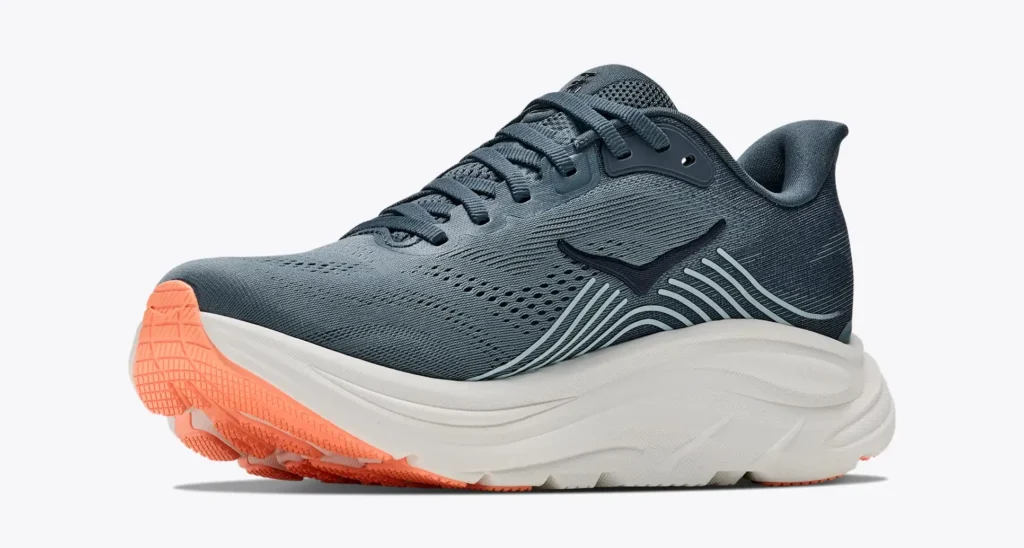
If you have developed a bunion, then you might benefit from a corrective orthotic like the one below. These are usually worn at rest for a fee hours at time to help correct you toe position. They can help in mild cases where the toe position is still correctable.

If you struggle to find an insole or orthotic which works for you then you could see Podiatrist, who can assess your foot and make an orthotic which is specifically designed for your individual toe.
 |
| A Podiatry Assessment |
Exercises and Stretches
If your toe is stiff then trying to stretch it can be helpful in gaining some extra movement. Support the base of the joint with one hand and the move the end part with your other hand. Start by gently bending the toe upwards and the. Holding for a few seconds.
 |
| Self Stretches of the Big Toe MTP Joint |
Repeat 5-10 times then do the same for the opposite movement, by bending the toe downwards. Doing this little and often every day for a few weeks will often help to improve the range of movement and therefore reduce pain.
The other exercises worth trying are the calf and achilles stretches as more mobility here, can reduce some of the tension on the forefoot particularly when walking.
 |
| Calf Stretch Achilles Stretch |
For the Calf Muscle Stretch, Lean against a wall with calf you want stretch behind. Keep your back foot on the floor and your knee straight. Now slowly lean forwards into the wall until you feel a stretch in the calf muscle just here. Hold for 15-30 secs and repeat 3 times.
For the Achilles Stretch. Stand with the foot you want to stretch behind you. Keep both feet flat on the floor and then bend both knees, as if going to sit down. Feel the stretch in the Achilles region just here. And again, hold for 15-30 seconds and repeat 3 times. I would do these exercises 2-3 times daily until your improvements have plateaud and then once every few days to maintain your flexibility.
Medication
If your big toe joint is inflamed, so maybe a bit red or swollen, or the pain which is usually mild and manageable has suddenly flared up badly, then anti-inflammatories can often help. You can use tablets like ibuprofen but the gels can also be effective as the joint is very superficial and so the gel can usually penetrate to an effective depth.

In the UK you can buy 5% strength ibuprofen gel over the counter under various brand names like Ibulieve or Voltarol, or the 10% strength gel can be prescribed.
Just make sure you check with a pharmacist before using anti-inflammatories as not everyone can take them. If you do use them though, they need to taken (or applied if it’s a gel) regularly as stated on the packet. They wont work if you use them now and then.
Diet & Supplements
Diet and supplements for arthritis is a topic all by itself and I have covered it in a separate video which you can see below.
Therapeutic Pain Relief Treatments
There are also a number of different treatments out there which can undoubtedly provide some therapeutic pain relief in the short but perhaps don’t do much else for the long term. This includes therapeutic heat which can help reduce pain. You can buy hot packs and electrically heated socks but one of the time honoured treatments is a hot wax bath which can be helpful for the skin as well and provided that lovely warmth.
 |
| A Therapeutic Wax Bath – Click for amazon link |
Over the years, people have also told me that the electrically heated foot spa’s, massagers and the newer circulation boosters have helped to reduce pain after a long day walking or standing. Just remember that these machines wont cure anything but they can make you feel better by reducing pain temporarily. You click the picture to take you to the product on amazon.


That wraps things up for the self-help treatments. Now lets move on to the other treatments that a specialist clinician can provide.
Injections
And the first thing that might be suggested is a cortisone injection. Because it’s a fairly small joint which is often quite gnarly at the joint margins when it becomes arthritic, I wound recommend using ultrasound image guidance to ensure accuracy.
 |
| Ultrasound Guided Injection |
Injections can be a very helpful treatment, particularly for an inflamed joint which might be throbbing and aching at rest. If it doesn’t help though, or the results are only short lived then it’s not advisable to have cortisone repeated again and again.
Instead, there are other injectable options such the viscoelastic products which serve as a joint lubricant and can be helpful for milf to moderate joint arthritis.
 |
| A Viscoelastic Product |
Surgery
Finally there are the surgical options. There are different procedures available depending on the degree of arthritis and the position of the toe, so basically what the X-Rays looks like.
If the arthritis is mild and the problem is more due to stiffness caused by overgrowth at the joint margins then a procedure called a Cheilectomy might be option. The surgeon just smooths done the bone spurs that are interfering with joint movement and hopefully that will restore a normal range of motion.
 |
| Cheilectomy |
If the arthritis is more advanced the options are usually either to fuse the joint so it no longer moves, and is therefore in longer painful, or to do a joint replacement. There are pros and cons to each if these options and you will need to discuss your individual situation with a surgeon.
 |
| Joint Fusion Joint Replacement |
If the toe is angled or if you have painful bunion then the surgery will need to try and correct the deformity. There are many different procedures that surgeons can choose from but one of the more common ones is the Scarf and Akin Osteotomy where the surgeon uses precise cuts to remove sections of bone and then titanium screws to correct the toe position.

 |
| Scarf & Akin Osteotomy |
Summary
Hallux Rigidus is a common condition which results in pain and stiffness of the big toe. The best self-help treatment is initially centred around footwear. Stiff soled shoes, rocker soled shoes and carbon fibre insoles can all help to offload the painful joint. Avoid anything with raised heel. Stretching exercises can sometime help improve the range of toe movement.
Additional treatment options include steroid injections, viscoelastic injections and surgery.
This article is for general information only and does not replace individual assessment. Start any exercise gently and stop if your symptoms worsen significantly. If you have severe or rapidly worsening symptoms, or you’re concerned about your health, please seek urgent advice from a qualified healthcare professional. See our full disclaimer for more information.