
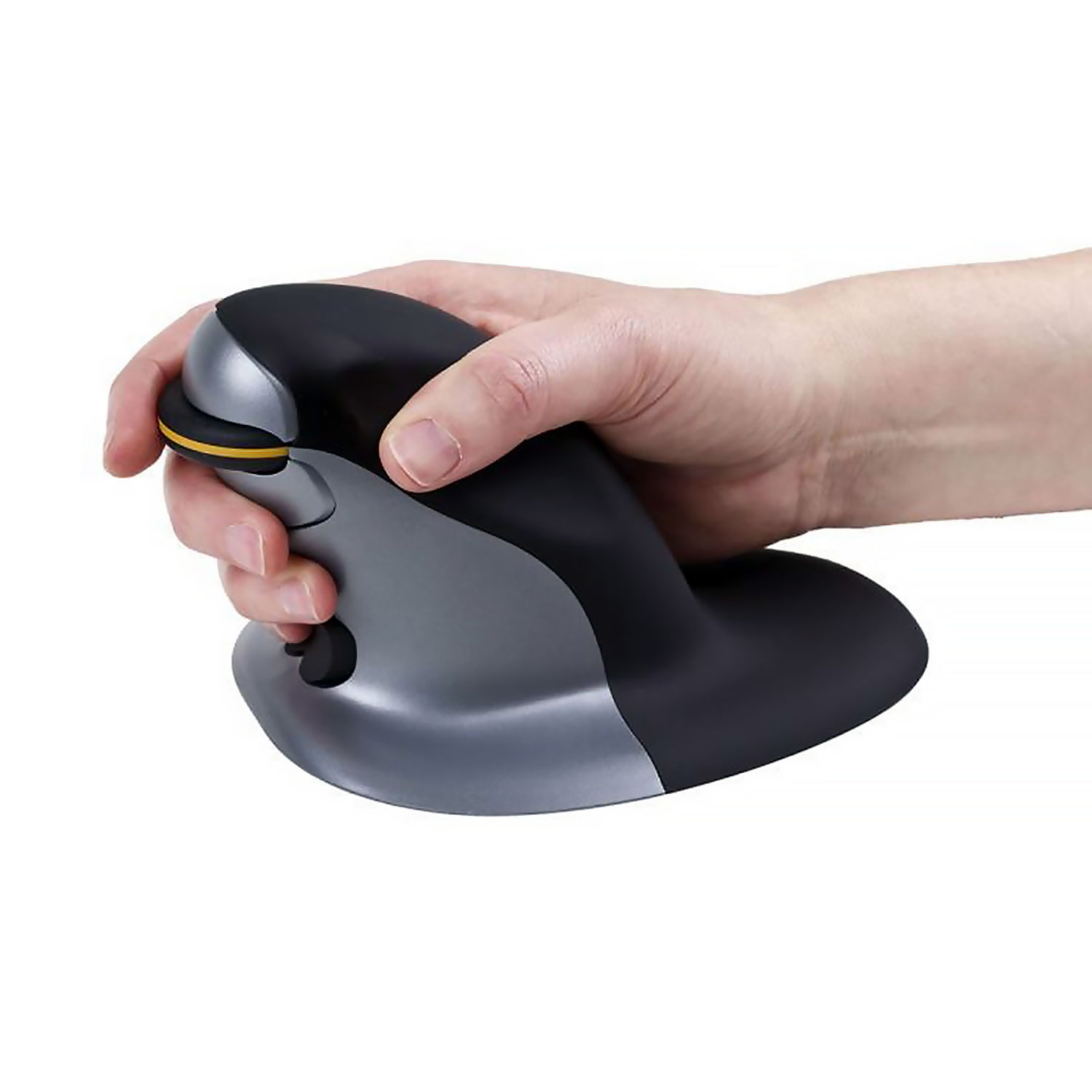
Penguin Ergonomic Vertical Mouse
Ad: most product links on this site are affiliate links. We earn a commission if you buy through them, at no extra cost to you. See our affiliate disclosure for details.
A traditional mouse puts the wrist in an unnatural, twisted position, which can contribute to overuse conditions like tendonitis. An ergonomic mouse like the Penguin holds the hand in a much more natural, “handshake” position. I use the Penguin mouse myself, and so do many of our clerical staff.
It takes a few days to get used to, but after that most people wouldn’t go back to a traditional mouse. If you use a mouse regularly, it can be a real game changer.
What I like
- Puts the wrist and forearm in a more natural, neutral position
- Encourages use of the forearm and upper arm muscles, with less wrist extension
- Comfortable for long periods of use
- Ambidextrous, so it works for left or right hand
- Adjustable sensitivity (400 to 1200 DPI) for fine control
- Works with Windows and Mac
- Comes in wired and wireless (rechargeable) versions
- Comes in 3 sizes
Things to know
- Check the size carefully. The manufacturer’s sizing is by hand length: measure from the crease at your wrist to the tip of your middle finger. Small is up to about 16 cm, Medium 16–18 cm, and Large over 18 cm. This listing is the Large, wired version, so make sure your link goes to the size and type you want.
- Give it a few days. The grip feels strange at first, and you may find the mouse slower for the first few days, until it becomes automatic.
- It’s a good idea to look at your whole set-up too: desk and chair height, keyboard position, and taking regular breaks. The mouse is only one part of the picture.
- Evidence that an ergonomic mouse prevents tendonitis is limited, but it reduces the awkward wrist positions that contribute to it, and many people find it more comfortable.
- If you already have wrist, forearm or hand pain, see my video on wrist tendonitis, and get it assessed if it isn’t settling.
Who it suits: anyone who uses a mouse regularly, especially people with wrist or forearm pain, or tendonitis, or who want to reduce the strain on their wrist.
Pairs well with: the Kinesis split keyboard, the laptop stand and a riser desk.
Watch my video on wrist tendonitis.