
Pain right at the top of your shoulder — roughly where a bra strap or rucksack strap would sit? Does it hurt when you reach your hand behind your back, lift your arm overhead, or lean your weight through that arm, perhaps doing a push-up or pushing yourself up out of a chair?
If that sounds familiar, you may have a problem with a small but important joint called the Acromioclavicular Joint, or AC joint for short. It’s easy to overlook — it’s small, and many people have never even heard of it — but when it goes wrong, it can be surprisingly limiting, and surprisingly painfull.
In this article, I’ll explain exactly what the AC joint is, what can go wrong with it, why it happens, how it’s diagnosed, and what you can do about it — including when exercises are enough, and when you might need an injection or even surgery.
The information can also be seen in video format below.
What Is the AC Joint?
Your shoulder isn’t actually one joint — it’s several joints working together. Most people only think of the big ball-and-socket joint, the glenohumeral joint. But right at the top of your shoulder, there’s a second, much smaller joint, where the outer end of your collarbone (the clavicle) meets a bony part of your shoulder blade called the acromion.
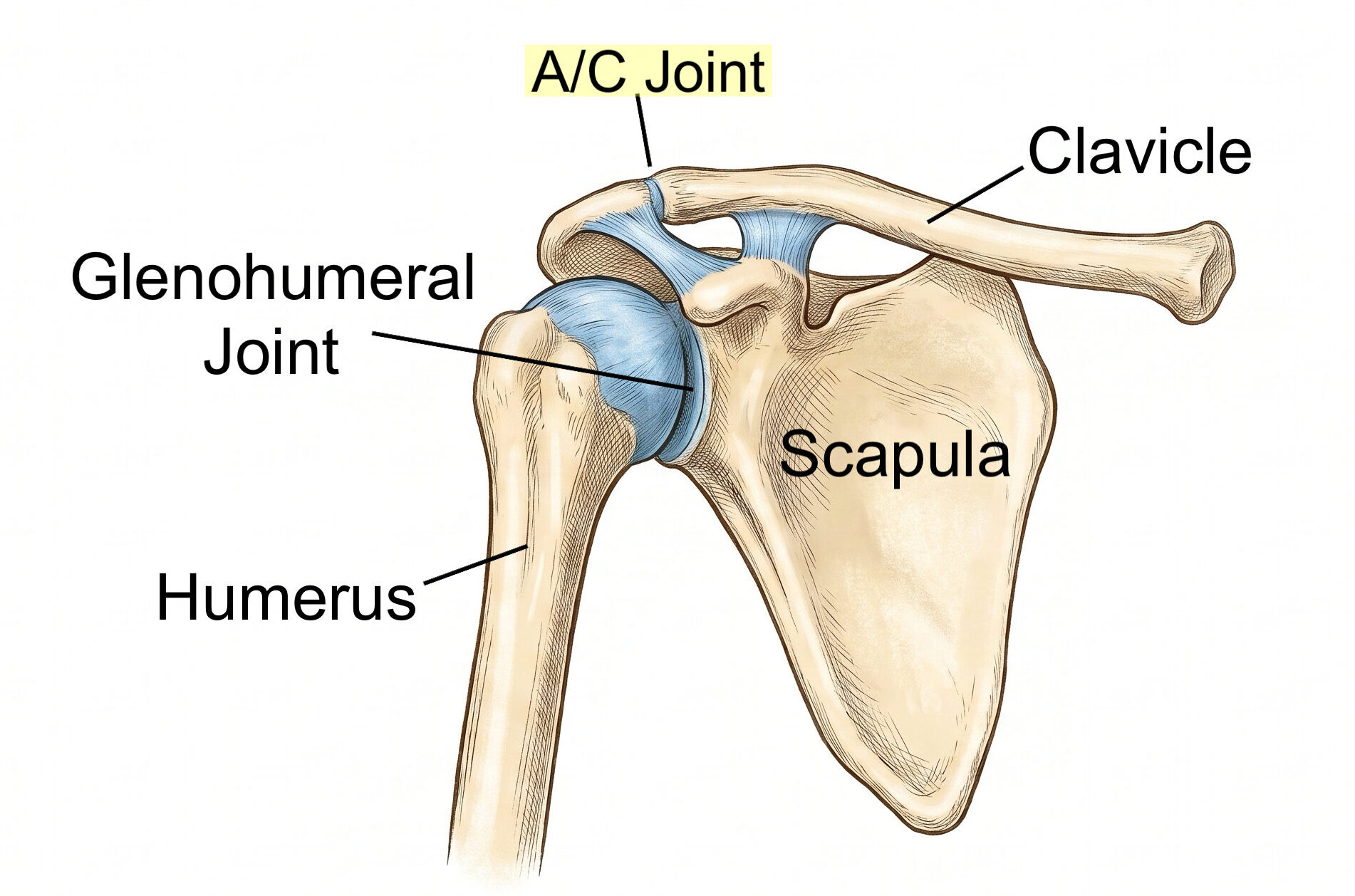
That junction — clavicle meeting acromion — is the acromioclavicular joint (AC Joint). It’s held together by a small joint capsule and some strong ligaments.
Despite being small, this joint has an important job. Every time you lift your arm overhead, your shoulder blade needs to rotate upwards, and the AC joint is one of the key hinges that allows that rotation to happen smoothly. It also transmits force between your arm and the rest of your skeleton, so any force that loads through your arm passes through this joint.
That’s really the key to understanding why this joint gets irritated: it’s small, but it’s constantly working, every time you move your hand above shoulder height, or push or lean through your arm.
What Can Go Wrong With the AC Joint?
There are three main things that tend to cause AC joint pain.
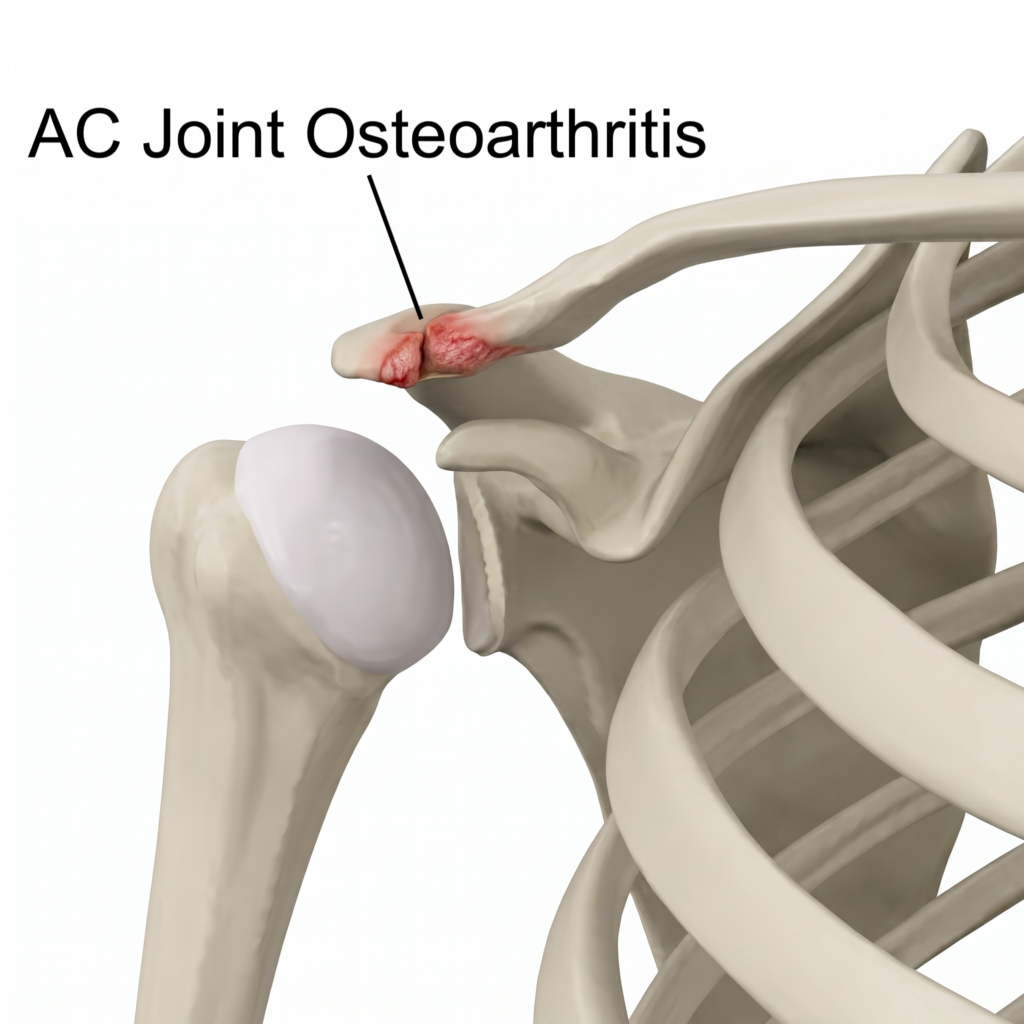
Osteoarthritis. Like any joint in the body, the AC joint can degenerate over time. The cartilage inside it gradually thins, and the joint can become inflamed, stiff and painful. This is the most common cause I see, particularly in people over about 40.
Trauma. Usually a fall directly onto the point of the shoulder, or sometimes a fall onto an outstretched hand. This can sprain, or even partially tear, the ligaments holding the joint together. Doctors often refer to this as an AC joint sprain, or, if it’s more significant, an AC joint separation — the collarbone can actually lift away from the shoulder blade, sometimes producing a visible bump.
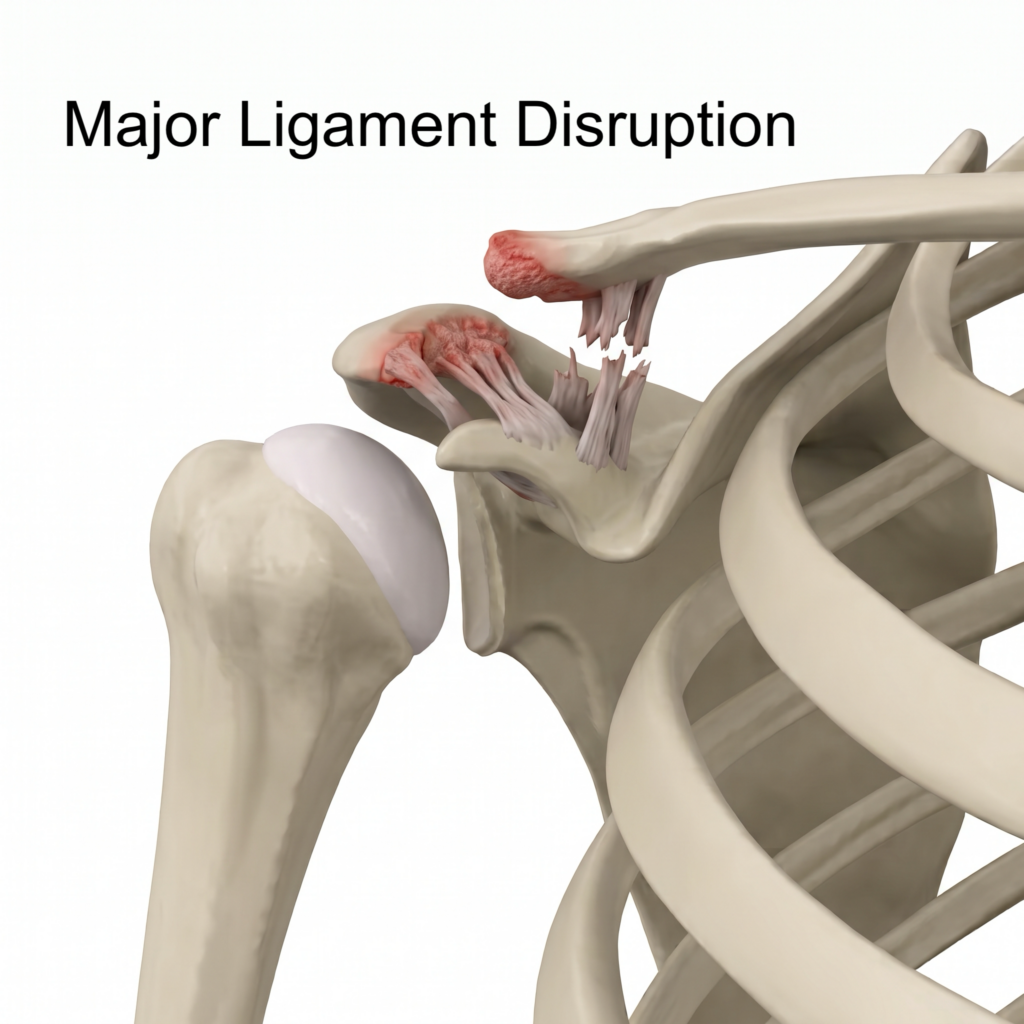
One reassuring point worth mentioning here: that visible bump doesn’t necessarily tell us how much trouble you’re going to have. After an AC joint separation has healed, some people are left with quite a noticeable bump on the top of the shoulder but have very little pain and function extremely well. We don’t treat how the shoulder looks — we treat the symptoms and how it’s actually functioning.
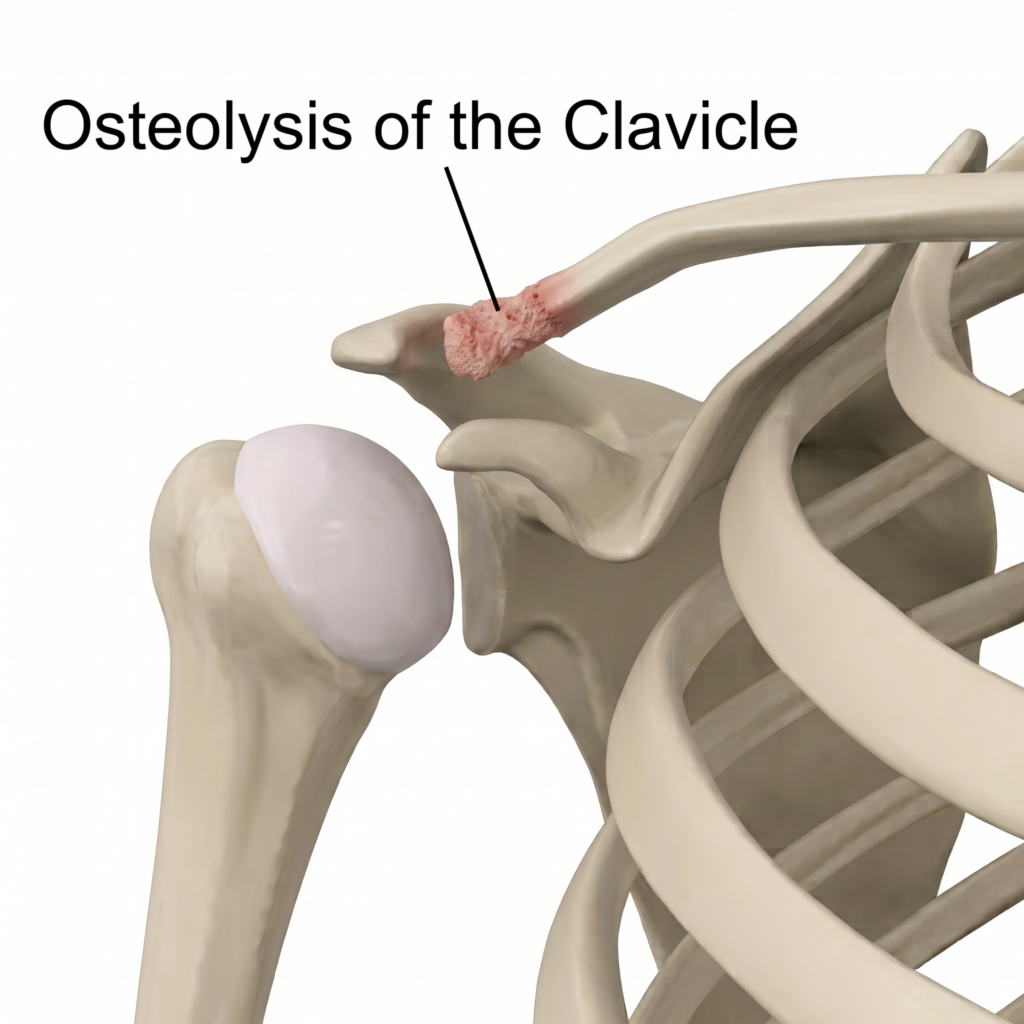
Osteolysis. Literally meaning “bone breakdown,” this tends to affect the very end of the collarbone, and it’s particularly associated with repetitive heavy loading — classically in people who do a lot of weight training, especially heavy bench pressing. It’s sometimes nicknamed “weightlifter’s shoulder” for that reason. It can also occasionally develop after a previous AC joint injury that never fully settled.
So three quite different mechanisms — osteoarthritis, a specific injury, or repetitive overload — but all of them affecting the same small joint, and often producing a very similar pattern of symptoms.
Why Does It Happen?
For osteoarthritis, it’s usually just age, genetics and cumulative use, although previous shoulder injuries, even years earlier, can make a joint more likely to develop arthritis later on.
For trauma, it’s almost always a direct blow or fall, so it’s very common in contact sports like rugby and American football, in cyclists who fall onto the shoulder, or simply after a slip or a fall at home.
For osteolysis, it’s really about load. Repetitive, heavy pushing movements — think bench press, heavy overhead pressing, or certain manual jobs involving a lot of pushing — place repeated stress through this small joint. Over time, the bone at the very tip of the clavicle can soften and start to break down. Essentially, it’s a stress reaction, similar in many ways to a stress fracture.
Sometimes there isn’t one single obvious explanation, and that’s fine. The important thing isn’t always pinpointing exactly why it started, but understanding what’s happening now, and what to do about it.
Symptoms
The symptoms of AC joint problems tend to be pretty consistent, whichever of the three causes is behind it.
The pain is usually very localised, right at the top of the shoulder, roughly where a bra strap or rucksack strap sits. If I ask someone to point with one finger to where it hurts, this is one of the few shoulder conditions where people can usually do that really precisely, right onto the joint itself.
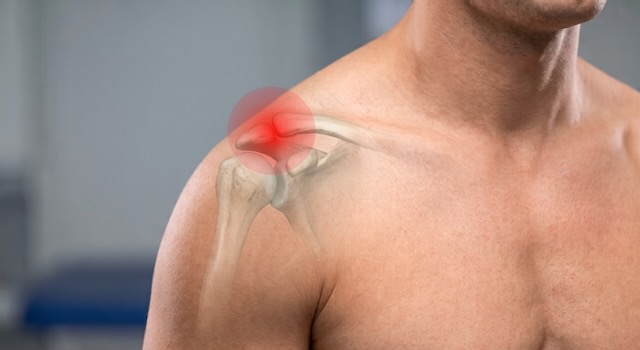
Certain movements tend to bring it on. Reaching your hand behind your back — like doing up a bra, or reaching into a back pocket — is often painful, because it compresses the joint. Lifting your arm up overhead is another common trigger, particularly right at the top of the movement. Weight-bearing through the arm — leaning on it, pushing yourself up, or doing a push-up — can also reproduce the pain, because you’re loading straight through the joint.
If the cause is traumatic, you might also notice some swelling, bruising, or even a visible step or bump at the top of the shoulder if the ligaments have been disrupted.
How Is It Diagnosed?
Diagnosis usually starts with listening carefully to how the pain behaves: where exactly it is, what brings it on, and whether there was a specific injury.
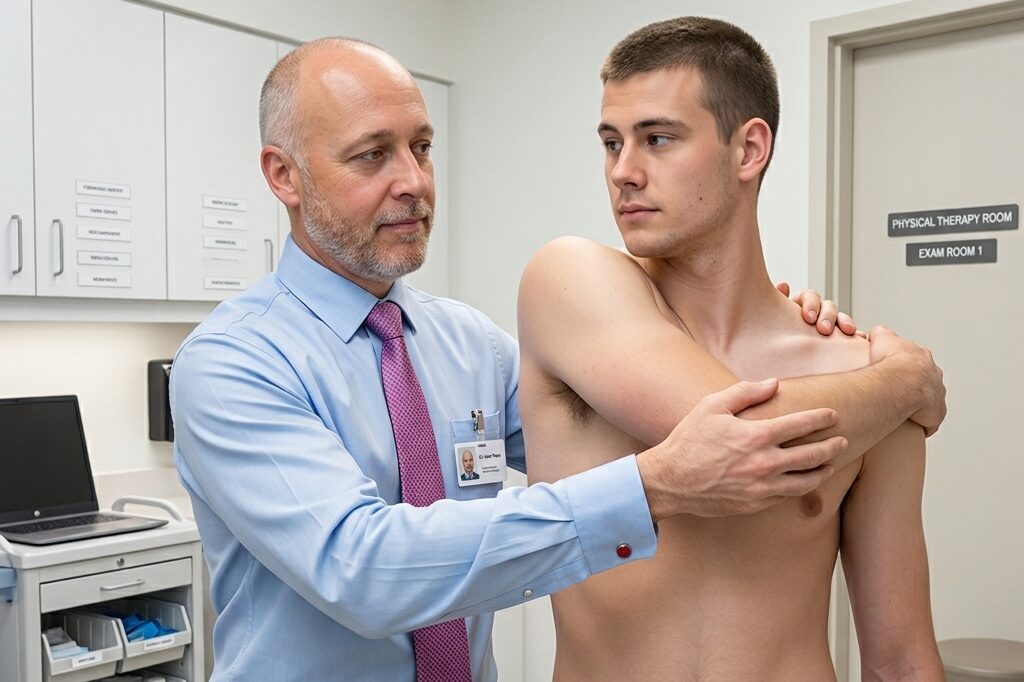
On examination, I’ll usually press directly over the AC joint — if that reproduces your usual pain, that’s a strong clue. I’ll sometimes then put your hand behind your back but stop just short of pain, and push on the joint again; this will usually cause worse pain than in the neutral arm position, and that pattern really suggests the AC joint is the problem. I’ll also use a couple of specific tests: the scarf test, where I bring your arm across your chest to compress the joint, and the AC resisted extension test, where you push your arm backwards against resistance.
In some cases, a diagnostic injection of local anaesthetic directly into the joint can be really useful too — if that temporarily takes the pain away completely, it strongly confirms the AC joint is the source.
Imaging can help confirm the diagnosis and understand severity. An X-ray can show joint narrowing or bony changes in osteoarthritis, widening of the joint in osteolysis, or an elevated collarbone in more significant traumatic separations. An MRI is sometimes used if we need more detail on the ligaments, or if the picture isn’t entirely clear.
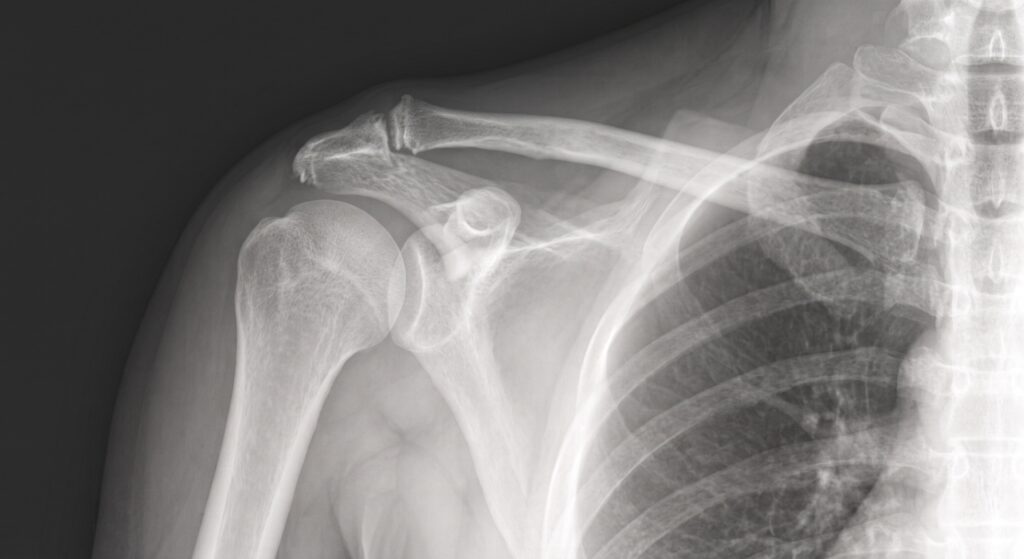
One thing worth flagging: a scan finding of arthritis doesn’t automatically explain your pain. If you scanned the shoulders of a large group of pain-free people in their 50s, 60s and 70s, a large number would show AC joint arthritis on the images despite having no symptoms whatsoever. We never just treat the scan — we treat the person, and interpret any imaging alongside your actual symptoms and examination findings.
Treatment: Self-Management and Exercise
The good news is that most AC joint problems — whether from arthritis, a mild sprain, or osteolysis — respond well to conservative treatment, and don’t need surgery.
The first step is usually a period of activity modification, not complete rest, but temporarily avoiding the specific movements that provoke it. That might mean easing off heavy bench pressing for a while, avoiding carrying a heavy bag on that shoulder, or being a little more mindful of reaching overhead.
Exercise is really important by they need to be chosen carefully. Early on, the focus is usually on scapular and rotator cuff control — gentle exercises that improve how your shoulder blade moves, without loading the AC joint directly. Rowing exercises, external rotation work, and gentle scapular exercises are typically well tolerated even when the joint itself is irritable.
As symptoms settle, we gradually reintroduce more demanding movements — pressing, overhead work, and eventually a slow, progressive return to whatever specific activity you want to do, including any sport that caused the problem in the first place.
A comprehensive exercise programme is demonstrated in the video below.
Manual Therapy
Hands-on treatment can also play a useful role alongside exercise. This might include gentle mobilisation of the AC joint itself, or soft tissue work to the surrounding muscles, particularly if there’s compensatory tightness around the neck, upper trapezius or pec muscles from holding the shoulder in protective positions.
Manual therapy on its own won’t fix the underlying problem, but it can help settle symptoms enough to make the exercise programme more comfortable and effective.
Injections
If symptoms aren’t settling with exercise and activity modification alone, an ultrasound-guided corticosteroid injection directly into the AC joint can be very effective, particularly for osteoarthritis and osteolysis. It reduces inflammation within the joint, which often gives a real window of reduced pain to make more progress with rehabilitation.
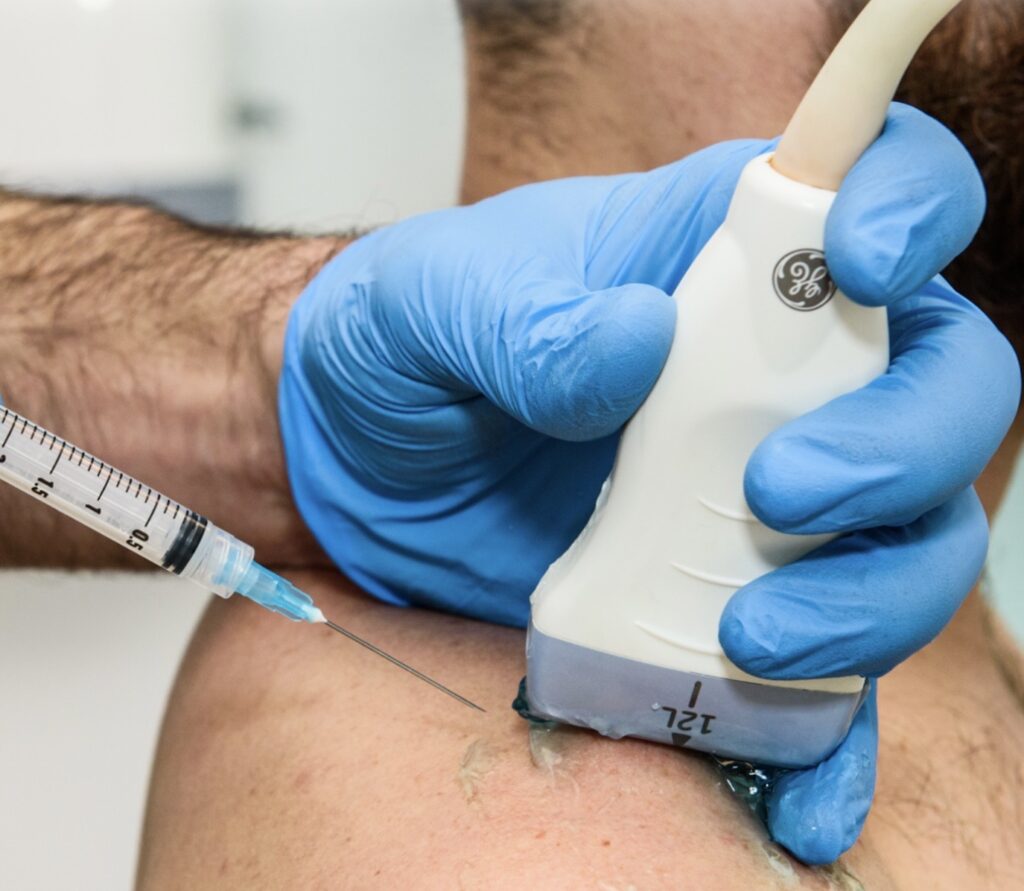
It’s worth saying — as with most joint injections — this doesn’t repair any underlying wear or damage. It’s most useful as a way of calming things down enough to let exercise-based treatment do its job properly.
Surgery
Surgery is only needed in a minority of cases.
For persistent osteoarthritis or osteolysis that hasn’t responded to conservative treatment, a relatively straightforward procedure called a distal clavicle excision — sometimes called a Mumford procedure — can be very effective. This involves removing a small portion of the end of the collarbone, which stops the two arthritic surfaces rubbing together; the gap between the bones is then left for the body to fill with scar tissue.
For more significant traumatic separations, where the ligaments have been substantially torn and the collarbone has shifted noticeably out of position, surgical reconstruction of the ligaments and realignment of the joint may be recommended, particularly in younger, more active patients.
It’s really worth stressing: the large majority of people with AC joint problems improve well without ever needing an operation.
Summary
The AC joint is a small joint at the top of the shoulder, where the collarbone meets the shoulder blade. It can be affected by osteoarthritis, by trauma such as a fall onto the shoulder, or by osteolysis from repetitive heavy loading.
The pain is usually very localised to the top of the shoulder, and tends to be provoked by reaching behind your back, lifting overhead, or weight-bearing through the arm.
Most people improve well with activity modification, targeted exercise, and sometimes manual therapy. Injections can be helpful if progress stalls, and surgery, while occasionally necessary, is only required in a small minority of cases.
Medical disclaimer: The information in this article is provided for general educational purposes and is not intended to replace individual medical assessment, diagnosis or treatment. If you have concerns about your health, please consult an appropriately qualified healthcare professional.