
Have you ever noticed a clicking, snapping or flicking sensation at the front or side of your hip when you walk, climb stairs or stand up from a chair? For some people it’s simply an unusual sensation, while for others it can become painful enough to interfere with sport and everyday activities.
This condition is known as Snapping Hip Syndrome. Although the snapping can be alarming, it is usually not a serious problem and, in most cases, responds well to conservative treatment.
In this article, I’ll explain the different types of snapping hip syndrome, what causes them, how they’re diagnosed, and the most effective treatment options.
The information is also presented in video format below.
What is Snapping Hip Syndrome?
Snapping Hip Syndrome describes a hip that produces a snapping, clicking or popping sensation during movement. Doctors sometimes use the Latin term Coxa Saltans, meaning jumping hip.
Despite how it feels, the hip is not dislocating. Instead, a tendon or band of tissue catches briefly on a nearby bony prominence before suddenly flicking across it.
A useful way to imagine this is like stretching an elastic band over the corner of a box. As the band catches and then slips over the edge, it creates a similar snapping effect.
Many people experience painless snapping that requires no treatment. Problems usually arise only when the snapping becomes painful or starts affecting daily activities or sport.
The Anatomy of a Snapping Hip
The hip is a ball-and-socket joint, made up of the femoral head (the ball) and the acetabulum of the pelvis (the socket).
Surrounding the joint are numerous muscles and tendons that move and stabilise the hip. Normally these structures glide smoothly over the surrounding bones. However, if a tendon becomes tight, irritated or slightly thickened, it may catch before suddenly slipping across a bony prominence.
There are three recognised types of snapping hip syndrome:
- External snapping hip
- Internal snapping hip
- Intra-articular snapping hip
The first two are by far the most common.
External Snapping Hip Syndrome
External snapping hip is the most common type.
The snapping occurs on the outside of the hip and is usually caused by either:
- The iliotibial band (ITB)
- The gluteus maximus tendon
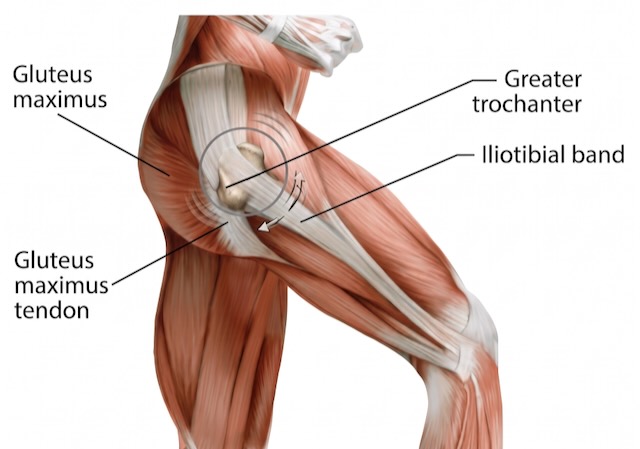
These structures move backwards and forwards across the greater trochanter, the large bony prominence on the outside of the thigh bone.
If the tissues become tight or irritated, they may suddenly flick across the bone, producing an audible or palpable snap.
Common symptoms
People often notice snapping when:
- Walking
- Running
- Climbing stairs
- Squatting
- Standing from a chair
- Rolling over in bed
- Lying on the affected side
Many people can actually feel the IT band flick beneath their hand placed over the outside of the hip.
Who gets it?
External snapping hip most commonly affects:
- Dancers
- Ballet performers
- Martial artists
- Runners
- Cyclists
- Athletes
It often develops during adolescence or following a growth spurt and is slightly more common in females because of the wider pelvis.
Internal Snapping Hip Syndrome
Internal snapping hip causes symptoms at the front of the hip or deep within the groin.
The tendon most commonly involved is the iliopsoas tendon, although the rectus femoris tendon can occasionally be responsible.
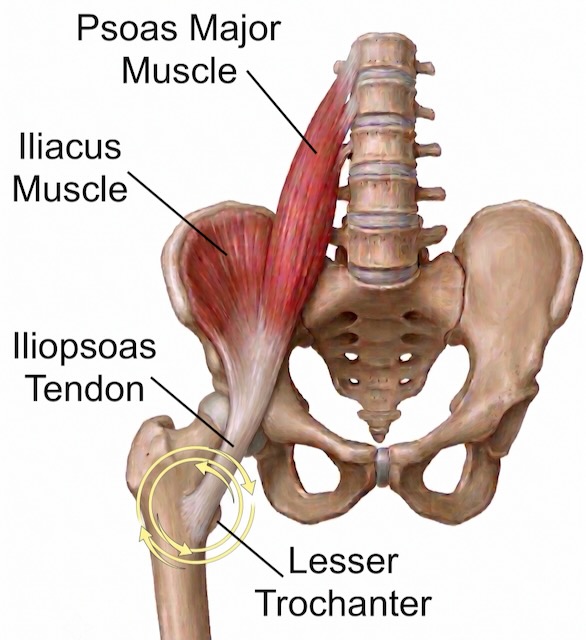
These tendons glide over nearby bony prominences as the hip bends and straightens. If they become irritated or tight, they may briefly catch before snapping across the bone.
Common symptoms
People often notice symptoms during:
- Standing up
- Climbing stairs
- Walking uphill
- Running
- Cycling
- Getting into or out of a car
- Getting out of bed
The sensation is often described as a deep clunk rather than a sharp click.
Who gets it?
Internal snapping hip is also most common in:
- Dancers
- Cheerleaders
- Footballers
- Martial artists
- Gymnasts
- Young athletes
Intra-articular Snapping Hip
The third and least common type occurs inside the hip joint itself.
Rather than a tendon snapping, the clicking may be caused by:
- A tear of the hip labrum
- Loose fragments of cartilage or bone
- Degenerative arthritis
This type often requires MRI or MR arthrogram imaging and assessment by a specialist hip surgeon.
What Causes Snapping Hip Syndrome?
There is rarely a single cause.
Instead, several factors usually contribute:
- Repetitive hip movements from sport or exercise
- Tight muscles and tendons
- Weakness of the gluteal and pelvic stabilising muscles
- Differences in hip anatomy
- Previous injury or surgery
- Sudden increases in training load
Women are affected slightly more often than men because the wider pelvis alters the line of pull of the tendons.
Why Does it Become Painful?
The snapping itself is not usually harmful.
Pain develops when repeated friction irritates the tendon or one of the small fluid-filled sacs called bursae that help reduce friction around the hip.
Symptoms typically develop gradually and may become worse during sporting activities or prolonged walking.
How is Snapping Hip Syndrome Diagnosed?
Diagnosis is usually based on:
- Your symptoms
- The location of the snapping
- Physical examination
- Reproducing the snapping during movement
Your clinician will also assess:
- Hip strength
- Flexibility
- Movement patterns
- Tenderness around the tendons
Do you need a scan?
Not always.
However, imaging may be useful if:
- The diagnosis is uncertain
- Symptoms are severe
- You are not improving with treatment
A dynamic ultrasound scan is particularly helpful because it allows the tendon to be watched while it moves.
MRI or X-rays may sometimes be used to exclude other causes of hip pain.
Treatment and Self-Management
The good news is that most people recover without surgery.
Treatment aims to reduce irritation while restoring normal hip function.
1. Modify activities
Complete rest is rarely necessary.
Instead:
- Reduce activities that trigger snapping
- Shorten running distances
- Avoid repeated deep squats
- Reduce uphill walking temporarily
Gradually return to activity as symptoms improve.
2. Stretching
Stretching may help reduce muscle tightness.
For internal snapping hip, gentle hip flexor stretches can reduce tension through the iliopsoas.
For external snapping hip, stretching the muscles around the outside of the hip may be beneficial.
Although people often talk about stretching the IT band, research suggests the IT band itself stretches very little. The benefit is more likely to come from improving the flexibility of the surrounding muscles.
3. Strengthening exercises
Progressive strengthening is the most important part of rehabilitation.
Exercises commonly include:
- Bridges
- Clams
- Side-lying leg raises
- Balance exercises
- Squats
- Step-ups
- Single-leg exercises
As strength improves, rehabilitation should gradually progress towards movements that replicate everyday activities or sporting demands.
Progression should always be gradual to avoid re-irritating the tendon.
A comprehensive series of stretches and exercises can be seen in the video below
4. Improve training habits
Many people also benefit from:
- Gradually increasing training volume
- Including recovery days
- Warming up properly
- Avoiding sudden increases in activity
I have created a separate exercise video that demonstrates a complete rehabilitation programme for both internal and external snapping hip syndrome.
Are Injections or Surgery Ever Needed?
Most people recover with exercise and activity modification alone.
If symptoms persist despite several months of rehabilitation, an ultrasound-guided corticosteroid injection around the irritated tendon or bursa may help reduce pain sufficiently to continue rehabilitation.
Surgery is rarely required and is generally reserved for persistent cases that fail to improve with comprehensive conservative treatment.
When Should You Seek Medical Advice?
You should seek further assessment if:
- The pain is severe
- Your hip locks or repeatedly gives way
- You cannot bear weight
- Symptoms followed a significant injury
- Symptoms continue to worsen despite rehabilitation
These features may suggest another condition requiring further investigation.
Summary
Snapping Hip Syndrome is a common cause of clicking or snapping around the hip and is usually caused by a tendon flicking over a nearby bony prominence rather than the hip joint coming out of place.
The two main types are external snapping hip, involving the IT band or gluteal tendons, and internal snapping hip, involving the iliopsoas tendon.
Although the snapping can be alarming, it is often painless and not harmful. When symptoms do become painful, the outlook is generally excellent. Most people recover with a combination of activity modification, progressive strengthening, stretching where appropriate and a gradual return to normal activity. Only a small number of people require injections, and surgery is rarely necessary.
The information in this article is intended for educational purposes only and should not replace an assessment by a qualified healthcare professional. If your symptoms are severe, worsening, or you are concerned about your diagnosis, please seek appropriate medical advice.