
By Stephen Bunting, Specialist MSK Physiotherapist
Gel injections are an increasingly popular alternative to cortisone (steroid) injections for people with osteoarthritis. There are two main types: viscoelastic injections based on Hyaluronic Acid (HA), and the newer synthetic hydrogel implants, the best known of which is Arthrosamid. This article explains what each product is, who is most likely to benefit, the risks and benefits of each, and what the research shows.
The information is also available in video format below
When Should a Gel Injection Be Considered?
Gel injections are used to treat osteoarthritis. They are most commonly used in the knee, although HA injections can also be used in many other arthritic joints, particularly the hip, the big toe and the base of the thumb. Three factors help decide whether a gel injection is likely to be suitable.
1. A confirmed diagnosis
Before considering a gel injection, a diagnosis of osteoarthritis is needed, ideally confirmed with at least an X-ray to show whether the arthritis is mild, moderate or severe.
2. The severity of the arthritis
Gel injections tend to work best when symptoms and joint changes are mild to moderate. If arthritis is severe on imaging, ideally it should not be at the very end stage (often called “bone-on-bone” arthritis), particularly if joint replacement has already been advised.
3. A settled joint
Gel injections work best in joints that are fairly settled rather than very swollen or inflamed. In a flared-up joint, a cortisone injection may be a better option, either before or alongside a gel injection.
How Do Gel Injections Differ from Cortisone?
Cortisone is an active drug. It is an anti-inflammatory steroid that chemically reduces inflammation within a joint. It works quickly, usually within a few days, and the active drug lasts about six weeks. This makes it very effective for settling an acutely painful, swollen joint.
The drawback of cortisone is that it is not well suited to frequent, repeated use, as this can lead to side effects. Gel injections fill this gap. They contain no pharmaceutical drugs and are designed to work over the longer term.
Internal link: Cortisone Injections: Benefits and Risks article
Hyaluronic Acid (Viscoelastic) Injections
What are they?
“Viscoelastic” is a physics term for a fluid that is both thick (viscous) and springy (elastic). These injections are based on hyaluronic acid, a natural gel-like substance found in the synovial fluid that lubricates healthy joints. In a healthy joint, HA helps to lubricate the joint, absorb shock and nourish the cartilage cells, and it has a mild natural anti-inflammatory effect. It looks and behaves rather like raw egg white.
In osteoarthritis, the synovial fluid can lose some of its HA content and become thin and watery. HA injections aim to replenish this with concentrated, laboratory-purified HA, temporarily restoring the fluid’s natural thickness and protective properties. I often describe this to patients as being like oiling a stiff hinge: the injection lubricates and cushions the joint so the joint surfaces can glide more easily.

Benefits and side effects
All HA injections are biodegradable. They break down naturally in the body over time, which means they can be repeated. Because they contain no active drugs, they do not carry the side effects associated with steroids. The joint may be sore for a few days after the injection, but significant side effects are uncommon.
HA injections do not work quickly. Their effect builds gradually over several weeks.
Low vs high molecular weight HA
The main difference between brands is the size of the HA molecule used:
- Low molecular weight products (around 500 to 1,000 kilodaltons) are broken down by the body more quickly, so they may need repeating more often, but they have minimal side effects.
- High molecular weight products (3,000 kilodaltons and above, with some as high as 6,000) break down more slowly and should last longer. However, they are more likely to trigger an immune response in the joint, causing a temporary flare-up of pain and inflammation. I am aware of cases where reactions to these products were severe enough that the joint needed to be washed out surgically.
- Hybrid products combine high and low molecular weight HA in an attempt to get the best of both, but they tend to be more expensive.
Manufacturers often claim that lower molecular weight products are better for mild to moderate arthritis and higher weight products for moderate to severe arthritis. Having used most of these products over the years, I have found the results to be broadly similar. I tend to avoid the heavier products because of the reactions described above, and use a lower molecular weight product without problems. In my experience, results typically last 6 to 12 months, which is somewhat longer than most of the research shows.
Who is most likely to benefit?
The typical patient I see for HA injections has mild to moderate arthritis, usually in the knee, is still active and is struggling with long-standing pain and stiffness that affects their quality of life. Three examples from my clinic illustrate how HA injections can be used:
- A 60-year-old tennis player with moderate to severe knee arthritis has an injection every six months. It keeps his knee at a level where he can continue to play. He is not pain-free, but he can manage. He notices the effect wearing off when his knee becomes stiffer in the mornings and after tennis, and each injection takes about three weeks to reach its full effect.
- A 50-year-old skier with moderate arthritis following a hockey injury in her 20s (and previous arthroscopic washouts and meniscal surgery) has an injection each December before her skiing holiday. It lasts nearly the whole year, and by the following November her knee feels “like a creaky door” again.
- A man in his 80s with severe, end-stage arthritis has chosen not to have a knee replacement. Despite my initial reluctance because of the severity of his arthritis, the injections have given him good relief, and he has them repeated every six to eight months. He noticed no difference between low, high and hybrid molecular weight products, so he continues with a lower weight product, which gives him no side effects and is the best value for money.
Synthetic Hydrogel Injections (Arthrosamid)
What is Arthrosamid?
The key difference between synthetic hydrogels and HA injections is that the hydrogel does not break down in the joint; it is not biodegradable. The main product used in Europe is Arthrosamid, which is licensed only for the knee. It is a gel made of 97.5% water and 2.5% polyacrylamide. Rather than coating the joint surfaces, it becomes permanently integrated into the joint lining (the synovium), where it helps to soften and cushion the joint.
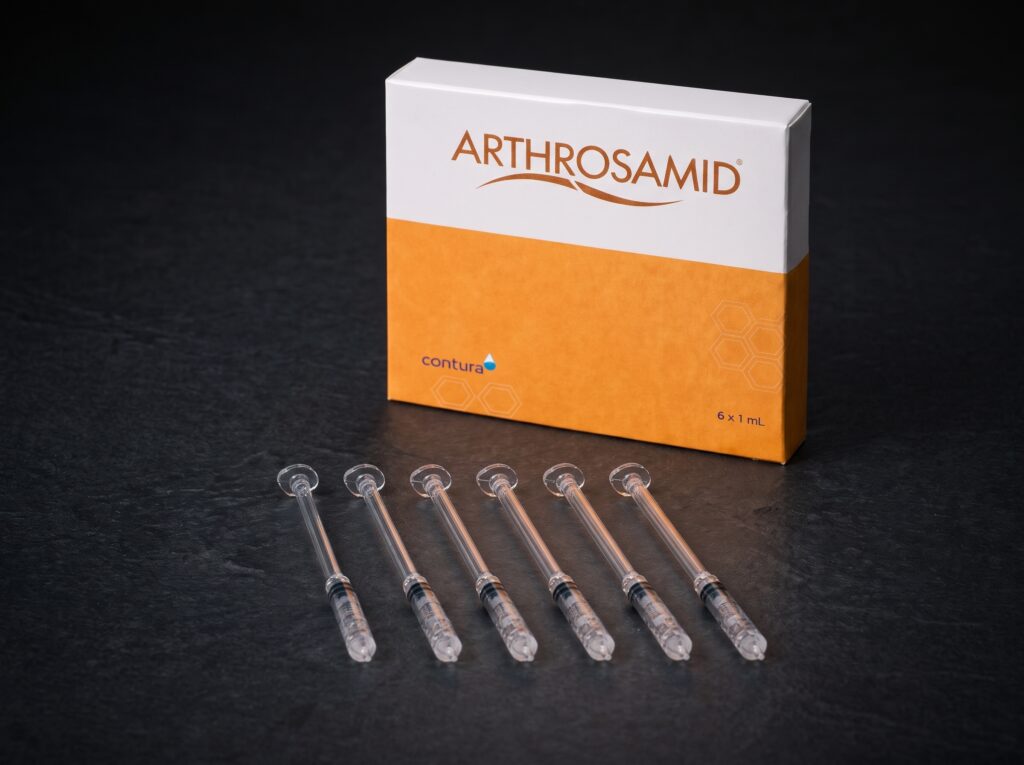
Cost and availability
Arthrosamid is expensive. In the UK, expect to pay around £3,000 for one knee, or around £5,000 for both knees treated in a single appointment. It is not available on the NHS, mainly because of its cost and the limited high-quality long-term research, so it is only available privately. As of November 2026, it is not available in the USA, as it does not have FDA approval, although it has been approved in Canada since 2024.
Who is most likely to benefit?
The manufacturer reports results lasting up to five years. Arthrosamid is generally used for people with more advanced knee arthritis who want to delay joint replacement surgery.
The importance of accurate injection
Because Arthrosamid is permanent, it is essential that the gel is placed inside the joint. It therefore needs to be injected under image guidance, usually ultrasound, which adds to the cost. If an HA injection misses the joint, it causes no harm, as it simply breaks down in the surrounding tissues. If Arthrosamid misses the joint, however, it remains permanently in whatever tissue it reaches, potentially causing further symptoms.

Benefits and side effects
The key benefit of Arthrosamid is its much longer-lasting effect, potentially several years. It does not appear to harm the joint cartilage or accelerate wear, but it does not regrow cartilage either. It is a cushion to help manage symptoms, not a cure.
An inflammatory joint reaction lasting up to four weeks is common after the injection. Cases of infection have been reported, which can lead to septic arthritis, a serious complication. For this reason, clinics often give antibiotics before the injection as a precaution.
Like HA, Arthrosamid does not work instantly. It typically takes 3 to 6 months to fully integrate into the joint lining. If the knee is very painful and inflamed, a cortisone injection may be advised first to settle it, with Arthrosamid given around six weeks later.
What Does the Research Say?
Hyaluronic acid
HA injections have been studied for decades. Overall, the research shows modest, short- to medium-term symptom relief, typically peaking at around two months and lasting up to about six months. Major medical guidelines are divided on whether the average benefit justifies routine use. In the UK, NICE’s 2022 osteoarthritis guideline recommends against offering HA injections, which is why they are difficult to access on the NHS. One reason is that the main alternative, cortisone, is much cheaper.
Two large reviews published in 2025 found that HA works best in people with mild to moderate (rather than severe “bone-on-bone”) osteoarthritis, in younger patients under 65 and in knees without active swelling. They also found that the effect builds gradually, peaking at around eight weeks and lasting roughly six months. Some studies suggest that repeated courses every 6 to 12 months may help delay knee replacement in some people.
Arthrosamid
The research on Arthrosamid is less extensive, as it is a relatively new treatment. The most important study is the ROSA randomised controlled trial, a double-blind trial across three centres in Denmark involving 239 adults with moderate to severe knee osteoarthritis. It compared a single 6 ml injection of Arthrosamid with a single 6 ml injection of Synvisc-One, a leading high molecular weight HA product. At six months, both groups had a similar reduction in pain. At 12 months, Arthrosamid performed slightly better, but the difference was not statistically significant, so it cannot be said to be genuinely better than HA.
The participants who received Arthrosamid were followed up for longer, and a 2026 paper reported their five-year results. Significant reductions in knee pain, stiffness and physical disability were sustained to year five, although the benefit tapered slightly by the fifth year as the arthritis naturally progressed. However, this follow-up had no comparison group, and of the 119 people who originally received Arthrosamid, only 58 were still being followed at five years. The results are encouraging, but not conclusive.
Research referenced
- ROSA trial: Arthrosamid vs Synvisc-One (Bliddal et al., Clinical and Experimental Rheumatology, 2024)
- ROSA trial: five-year follow-up (Bliddal et al., Clinical and Experimental Rheumatology)
- Hyaluronic acid for osteoarthritis: systematic review and model-based meta-analysis (Cao et al., Osteoarthritis and Cartilage, 2025)
- Hyaluronic acid injections for knee osteoarthritis: an umbrella review (Bruyère et al., Maturitas, 2025)
- NICE guideline NG226: Osteoarthritis in over 16s (2022)
Common Questions
1. How quickly do gel injections work?
Neither type works quickly. HA injections build up over several weeks, typically peaking at around eight weeks. Arthrosamid takes 3 to 6 months to fully integrate into the joint lining.
2. How long do they last?
Research shows HA injections last up to about six months, although some people find they last closer to a year. Arthrosamid has shown benefits lasting up to five years.
3. Can gel injections be repeated?
HA injections can be repeated, as they break down naturally in the joint; many people have them every 6 to 12 months. Arthrosamid is permanent and is intended as a single treatment.
4. Can gel injections be used in joints other than the knee?
HA injections can be used in many arthritic joints, including the hip, big toe and base of the thumb. Arthrosamid is currently licensed only for the knee.
5. Can I have a cortisone injection as well?
Yes. If a joint is flared up and swollen, a cortisone injection is usually the better first option and can be given before a gel injection. For Arthrosamid, a gap of around six weeks is typical.
6. Are gel injections available on the NHS?
Generally not. NICE recommends against HA injections for osteoarthritis, and Arthrosamid is only available privately.
Summary
- HA injections and Arthrosamid both offer a steroid-free option for treating osteoarthritis.
- HA can be used in many joints; Arthrosamid is currently licensed only for the knee.
- HA is best suited to mild to moderate arthritis. Its effect builds over about eight weeks and, according to the research, lasts up to about six months, although some people get closer to a year. It breaks down naturally, has minimal side effects and can be repeated.
- Arthrosamid is mainly used in moderate to severe knee arthritis, often to delay joint replacement. It becomes a permanent part of the joint lining and has shown benefits for up to five years, but it is expensive, only available privately and supported by limited long-term research.
- Both work best in settled joints. If a joint is flared up or swollen, a steroid injection is usually the better first option.
This article is for general information only and does not replace individual assessment. Start any exercise gently and stop if your symptoms worsen significantly. If you have severe or rapidly worsening symptoms, or you’re concerned about your health, please seek urgent advice from a qualified healthcare professional. See our full disclaimer for more information.